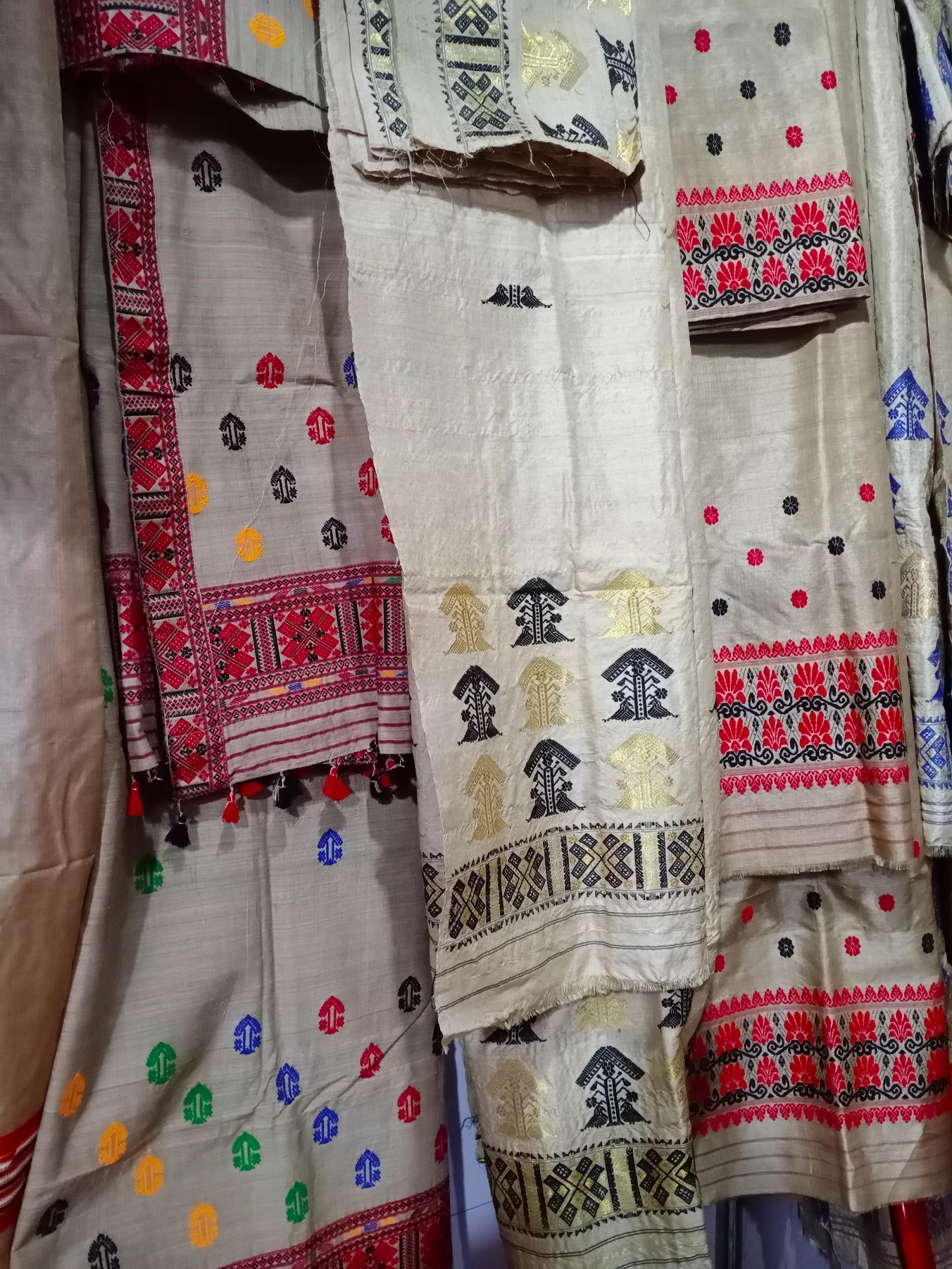
Somewhere in the Brahmaputra valley, a silkworm is spinning gold.
Not metaphorically. Not through dye or treatment or chemical process. The silk that emerges from the cocoon of Antheraea assamensis is naturally, irreversibly, impossibly golden — a warm amber that no factory has ever been able to replicate, and no other creature on earth has ever been known to produce.
It is called Muga. And it exists only in Assam.
The Things That Sound Like Invention
There are things about Muga silk that sound like invention until you hold a piece of it.
That the colour deepens with age — that a Muga silk garment worn and washed for decades becomes more golden, not less. That a great-grandmother's mekhela chador, folded and passed down through generations, glows warmer than the day it was woven. Every other fabric fades. Muga intensifies. It is, quite literally, the only textile in the world that improves with time.
That the silkworm cannot survive outside the Brahmaputra valley. Scientists have tried. Sericulture departments have tried. The Antheraea assamensis has been carried to Bengal, to Karnataka, to controlled laboratory environments — and it dies. It feeds on two trees: Som and Soalu, which grow along the specific floodplains of the Brahmaputra. Remove it from that ecosystem, from that humidity, from that particular combination of river air and forest floor, and the silkworm simply refuses to live. Assam did not choose Muga. Muga chose Assam.
That for centuries, wearing Muga was a privilege the Ahom kings reserved for themselves. The Swargadeo — the divine king of the Ahom kingdom — wore Muga. His court wore Muga. The commoner who was caught wearing it was punished. In a world where gold was currency and status, Assam had a fabric that was gold.
The Women at the Loom
The women who weave Muga have been doing so since before anyone thought to write it down.
In villages along the Brahmaputra — in Sualkuchi, called the Manchester of the East, and in quieter weaving hamlets deeper into the valley — Assamese women sit at handlooms that their grandmothers used. The loom is not a machine. It is a conversation between the weaver and the thread, conducted in the language of tension and rhythm. A single mekhela chador — the two-piece traditional Assamese garment — can take weeks to complete. The finest pieces take months.
The weaving is not a job in the way we use that word. It is closer to something that belongs to the identity of an Assamese woman the way language belongs to a people. Girls learn at their mothers' looms. The patterns — the geometric motifs, the floral borders, the traditional designs passed down without instruction manuals — live in the muscle memory of the hands before they are ever named.
When an Assamese bride dresses for her wedding, she wears Muga. Not because it is fashionable. Because in Assam, a bride does not wear gold. She wears Muga. They are the same thing.
What Muga Refuses
What makes Muga extraordinary is not just what it is, but what it refuses to be.
It refuses to be replicated. Laboratories have spent decades attempting to synthesise that particular golden hue — the tone that sits somewhere between champagne and amber, neither fully yellow nor fully brown. They have failed. The colour is a product of the silk's protein structure, shaped by the specific diet of the silkworm and the specific climate of a specific valley. You cannot order it. You cannot manufacture it. You can only grow it, in one place, in one way, under one sky.
It refuses to fade. Put Muga beside any other silk — Chinese, Mysore, Tussar — and wash them both ten times. The others will soften in colour. Muga will hold, and then deepen. The passage of time that diminishes everything else only enriches it.
It refuses to be ordinary. A well-preserved Muga mekhela chador from fifty years ago is worth more today than when it was made — not just in sentiment, but in the market. Collectors seek old Muga. Families guard it. Museums acquire it. There are pieces in Assamese households that have been worn at six generations of weddings.
What Is Being Lost
The Som and Soalu trees that the silkworm depends on are disappearing. Forests along the Brahmaputra have been cleared for agriculture, for development, for the grinding logic of a growing population needing land. The weavers are ageing. The young are moving to cities where the income is steadier and the hours are shorter. A craft that survived six centuries of Ahom kings and British colonists and Partition and floods is now quietly threatened by the same forces threatening everything handmade everywhere.
Muga silk received a Geographical Indication tag in 2007 — the legal acknowledgement that it belongs to Assam and only Assam. But a tag does not plant trees. It does not bring the young back to the loom.
What might, perhaps, is this: that somewhere in the Brahmaputra valley, a silkworm is still spinning something the world has no equivalent for. That the women who turn that thread into cloth are keeping alive something that cannot be replicated, in any lab, in any country, at any price. One weave at a time. One generation at a time.
If you ever hold a piece of old Muga silk — really hold it, in the right light, near a window on a clear morning — you will understand why the Ahom kings kept it for themselves.
It does not look like fabric. It looks like something the river dreamed.