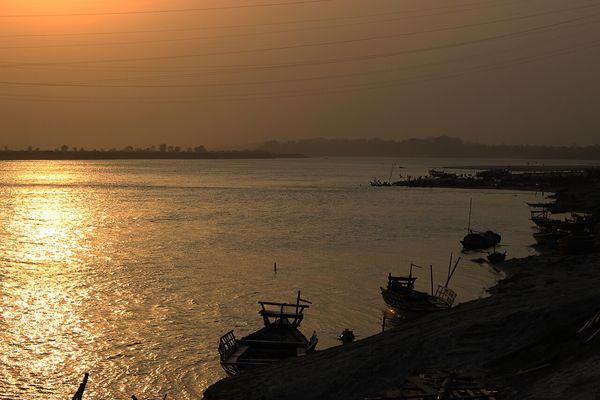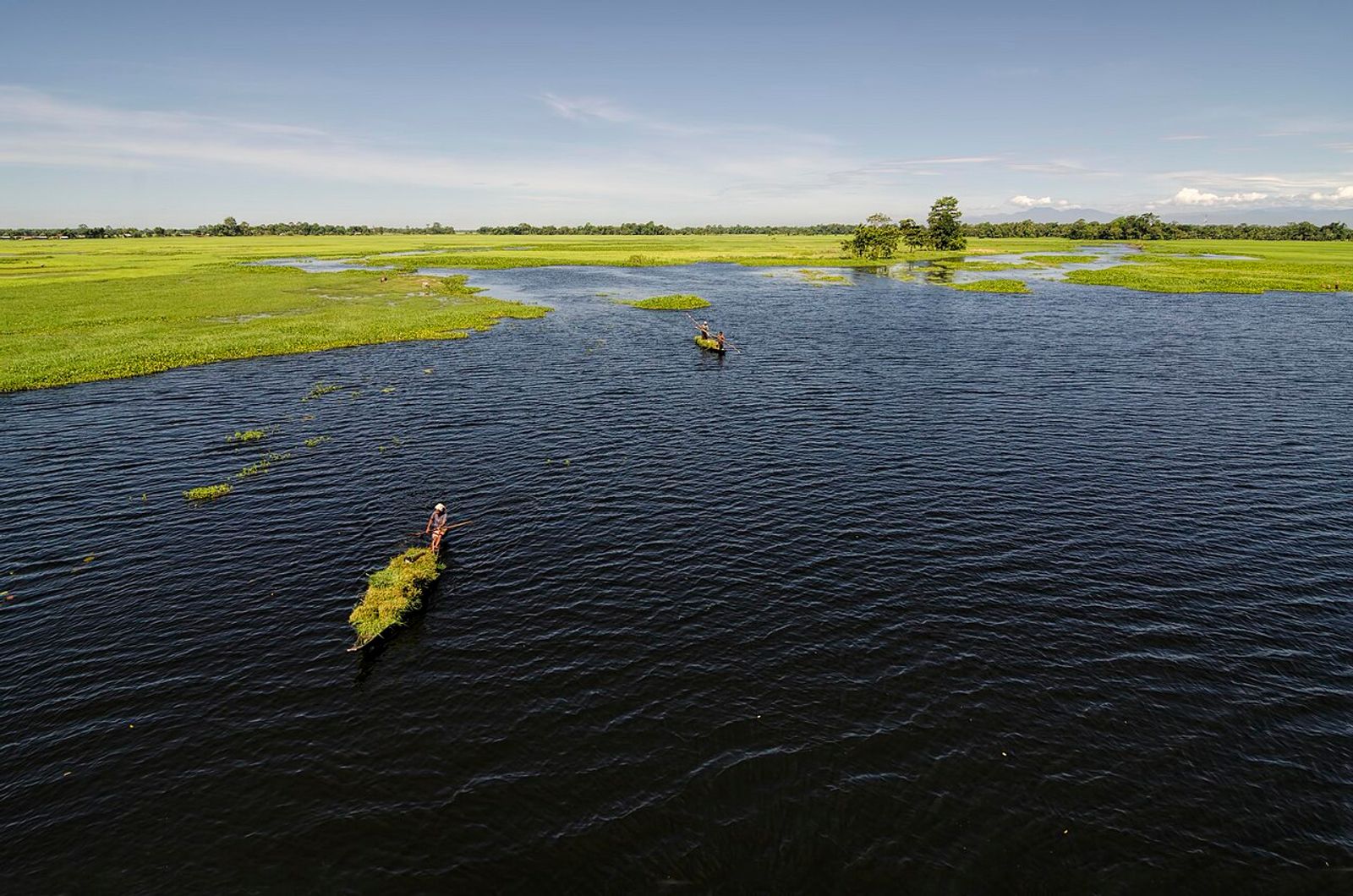
The Brahmaputra is not a well-behaved river. It is one of the largest rivers in the world by water volume, carrying sediment from the Tibetan plateau and the eastern Himalayas through a valley that has been geologically unstable for ten thousand years. It shifts its course. It floods catastrophically. It creates islands and destroys them. Somewhere in this arrangement, the people of Assam built a civilisation on the largest river island in the world, and have been maintaining it against the Brahmaputra's indifference ever since.
Majuli — the name comes from the word for land between two rivers — is roughly 540 square kilometres today. In the 1950s it was 1,255 square kilometres. The Brahmaputra has consumed nearly half of it in seventy years. Before that, floods in the seventeenth century reshaped the island into something resembling its current form. Before that, there is recorded history, and before that, other islands in other configurations, and through all of this, people lived here, grew crops, practised art, and chose, generation after generation, not to leave.
Sankardeva and the Satras
In 1468, in the foothills above what is now Assam, a child was born who would, by the time he died nearly a century later, have taken apart and reassembled the entire architecture of faith in this valley. Srimanta Sankardeva was a poet before he was a reformer. He wrote devotional songs when he was young and built institutions when he was old, and the institutions he built were unlike anything before them — part monastery, part theatre, part school, part artist's workshop.
His movement rejected caste, rejected idol worship, rejected the elaborate ritual apparatus of mainstream Hinduism, and replaced it with something radical: devotional music and drama, and a direct relationship between the worshipper and the divine that required no intermediary. He called these institutions satras. There are twenty-two satras on Majuli today. They are the reason the island matters.
Each satra maintains a distinct tradition of art, music, and monastic life. The Auniati satra holds a collection of Ahom royal artefacts, antique metalwork, and manuscripts that have survived floods and fires and the Brahmaputra's patience. The Kamalabari satra is known for its theatre: Bhaona performances staged here continuously since Sankardeva's time, using masks and costumes and a staging style that has shaped classical theatre across northeast India.
The Mask Makers
The masks of Majuli are among the great art objects of Assam, and almost nobody outside the state knows they exist. They are made from a combination of clay, bamboo, cloth, and cow dung, layered and shaped and dried over weeks into forms that can be three feet wide and still light enough for a dancer to wear. The largest masks — representing demons, gods, and animals in the Bhaona plays — are worn by performers who control the mask from inside, working the features through a system of internal levers. A single mask can take three months to make.
One of the men still making them has been at it for decades. The mask he is working on now — a demon for the autumn Bhaona — will be the latest in a line of masks made in the same tradition, passed to performers who will carry them in ways he cannot predict, across seasons and floods and the Brahmaputra's next mood. His teacher's masks are still in use at the Kamalabari satra. In Majuli, what you make does not belong to you. It belongs to the next generation.
There are perhaps a dozen master mask-makers still active on Majuli. The Assam government has recognised the form as a geographical indication — it can only be called a Majuli mask if it is made on the island. This is a meaningful protection but a narrow one. The island is still shrinking.
The River's Argument
Every year the river takes more. The erosion is not constant — it comes in floods, sudden massive reshapings that can remove kilometres of bank in a single monsoon. Villages that existed in one location move inland, sometimes by choice, sometimes when the ground beneath them simply disappears. Majuli's population has been declining for decades, not from birth rates but from outmigration: people who have watched the river take their fields and their ancestors' homes and decided the Brahmaputra's argument was one they could not continue answering.
Those who remain make a different calculation. The satras are not going to move. The mask tradition is not going to move. The Bhaona stages that have been set up in the same orientation to the sky for five centuries are not going to move. The river has been here longer than the satras, and the satras intend to outlast the river's current mood.
UNESCO placed Majuli on its tentative World Heritage list in 2004. The listing acknowledges what the island is — a living cultural landscape, where the art and the community and the geography are inseparable, where the river that threatens the island is also the reason the island exists. The Brahmaputra made Majuli. The Brahmaputra is unmaking it. What remains, in the middle of this argument, is a civilisation that has been performing devotional theatre on a moving sandbar for five hundred years, and shows no sign of stopping.