Her grandmother taught her the angle of the wrist — not with words, but by reaching across and correcting it, mid-dance, in the way you correct something you have been doing the same way for sixty years. The Bihu dance is not taught in any studio. It lives in the space between people: passed hand to wrist to hand across generations, in courtyards and harvest fields and the brief open ground before the meji burns.
Assam has not one Bihu but three, and the difference between them matters. Rongali Bihu arrives in April, when the planting season begins and the Brahmaputra valley loosens after winter. Bhogali Bihu comes in January, when the harvest is in and the granaries are full and there is reason to be generous. Kongali Bihu falls in October, when the fields are standing but the harvest has not yet come — when there is nothing to spare, and the festival is quiet: a lamp lit in the dark rather than a fire.
Rongali is the one the world knows. The Bihu dance, the gamosa, the week-long gathering that can consume entire villages — these belong to Bohag Bihu, the Assamese new year. It is the most photographed, the most performed, the most exported version of something that was never meant for export.
The Dance
The dhol accelerates first. This is what you feel in the Bihu dance before you understand it — the percussion settling somewhere below the ribs, the body responding before the mind has caught up. Then the pepa horn cuts through, high and sharp, and the dancers begin.
The footwork is intricate and specific — not improvised, not approximate. The hand gestures carry meanings that trained performers read the way musicians read notation, and the whole performance accelerates through the length of the piece until the final section, where the tempo becomes something between music and controlled chaos. Men and women perform together, which was once considered scandalous by incoming religions and administrations, and has been performed anyway for as long as Assam has existed.
The dance was almost suppressed. British missionaries in the nineteenth century considered it immoral. What kept it alive was what keeps most things alive in Assam: the villages, which continued doing what they had always done without waiting for official approval.
The Gamosa
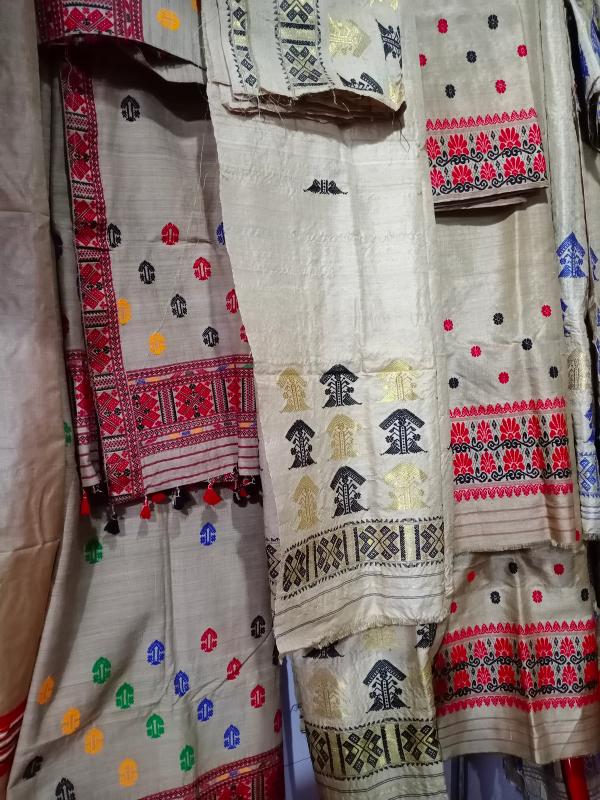
The gamosa she is handing across is white cotton with a red border. Her grandmother wove it on a loom that is still in the back room. It will be given again — at a wedding, at a festival, at a funeral — and then again, and again, until the weave softens to something between cloth and memory.
The gamosa is given as a mark of respect and as a mark of affection — both simultaneously, both sincerely, which tells you something about how Assamese sensibility works. In 2023 it received a Geographical Indication tag, meaning it can only be called an Assam gamosa if it is made in Assam by traditional methods. Those who have grown up with it can feel the difference in their hands before they ever look at the pattern.
Bhogali and the Meji
Bhogali Bihu, the harvest festival, is the Bihu of fire. Communities build the meji — a large structure of bamboo and thatch — in the fields and set it alight at dawn on the final day. The fire is enormous and intentional. It marks the end of harvest season, the transition from plenty to ordinary time. Standing at the edge of the meji before sunrise, with January cold in the Brahmaputra valley and the mist still on the fields — this is not spectacle. It is calendar. It is the year being put down so the next one can begin.
Kongali
And then there is Kongali. The third Bihu, in October, that none of the photographs show.
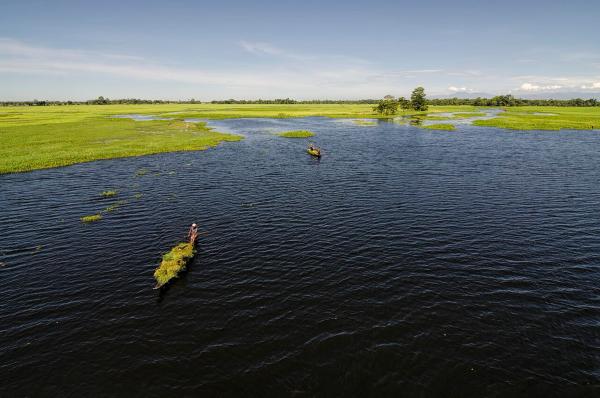
The paddy is standing in the fields. The harvest has not come. There is nothing to burn, nothing to give away, nothing to spare. So Kongali is quiet — a lamp lit, set floating on the water, a prayer said into the dark for what is standing and not yet gathered. Not a celebration of what is. A celebration of what is almost.
Bihu is not a festival that happens to Assam. It is how Assam marks time — the agricultural, the spiritual, and the celebratory folded into three separate fires lit at three separate moments in the year. Miss one and you have missed a season. Miss all three and you have missed the year entirely.