Rabindranath Tagore visited Tripura three times. He came not for the architecture and not for the scenery. He came for Maharaja Birchandra Manikya, who was his friend, and who was himself a poet. This was an unusual thing for a ruling monarch to be. Tagore recognised it immediately.
The Manikya dynasty had ruled Tripura for approximately five hundred years — from the fourteenth century to 1949, when the kingdom acceded to India. Five centuries is a long time for a dynasty to hold. The Manikyas managed it partly through political skill, partly through geography — Tripura is surrounded on three sides by Bangladesh, which protected it from certain directions of external threat — and partly through cultural patronage that made the kingdom a genuine centre of Bengali literature, music, and art.
The Poet-King
Birchandra Manikya wrote poetry, composed music, and corresponded with Tagore as an equal — not as a patron writing to an artist, but as one writer to another. The letters between them are in the archive at the Ujjayanta Palace. Tagore dedicated work to the Maharaja. The Maharaja sent Tagore manuscripts, requests, and the kind of disagreements that only exist between people who take each other seriously.
This history is one of the strangest in Bengali cultural life — a kingdom in the far northeast, bordered by what is now Bangladesh on three sides, producing a court culture that engaged with the finest minds of the Bengal Renaissance as peers. Most of the people who study Tagore do not know about it. Most of the people who visit Tripura do not know about it.
The Ujjayanta Palace
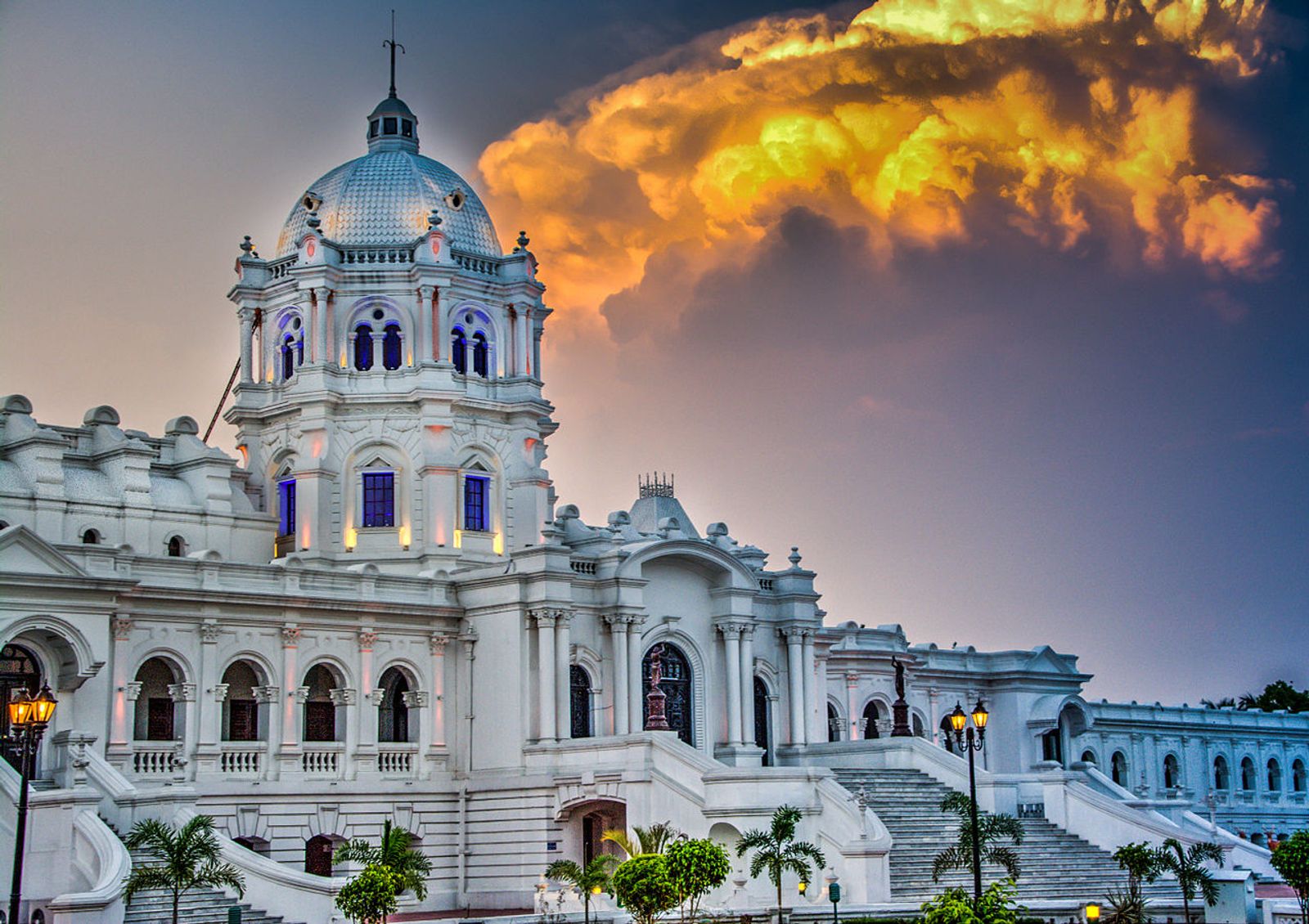
The Ujjayanta Palace was built in 1901 by Maharaja Radha Kishore Manikya — two floors, a durbar hall with a teak ceiling, a library with wooden floors from Burma, a collection of ceremonial weapons, and a throne room designed for a king. It sits at the centre of Agartala behind a long formal garden, its white walls and Mughal-inflected domes catching the afternoon light in a way that feels deliberate. It is a museum now. The throne room is walked through by visitors who have come, mostly, to see the architecture.
The Manikya dynasty ruled Tripura for approximately five hundred years. They wrote poetry and built friendships with Nobel laureates while governing a kingdom that almost nobody in the rest of India had heard of. This is a thing that happens in the Northeast — entire civilisations of extraordinary sophistication, operating just beyond the awareness of the country that now contains them.
What the Palace Holds
The durbar hall is intact. The teak ceiling is intact. On a quiet weekday afternoon, the rooms hold the specific silence of buildings that have outlasted their purpose — not desolate but waiting, the way libraries feel on the day after they close. The manuscripts are in the archive. The letters between Tagore and the Maharaja are in there. The music scores that the Manikya court commissioned are in there.
The stories are not waiting. They are simply in rooms that not enough people have entered yet.