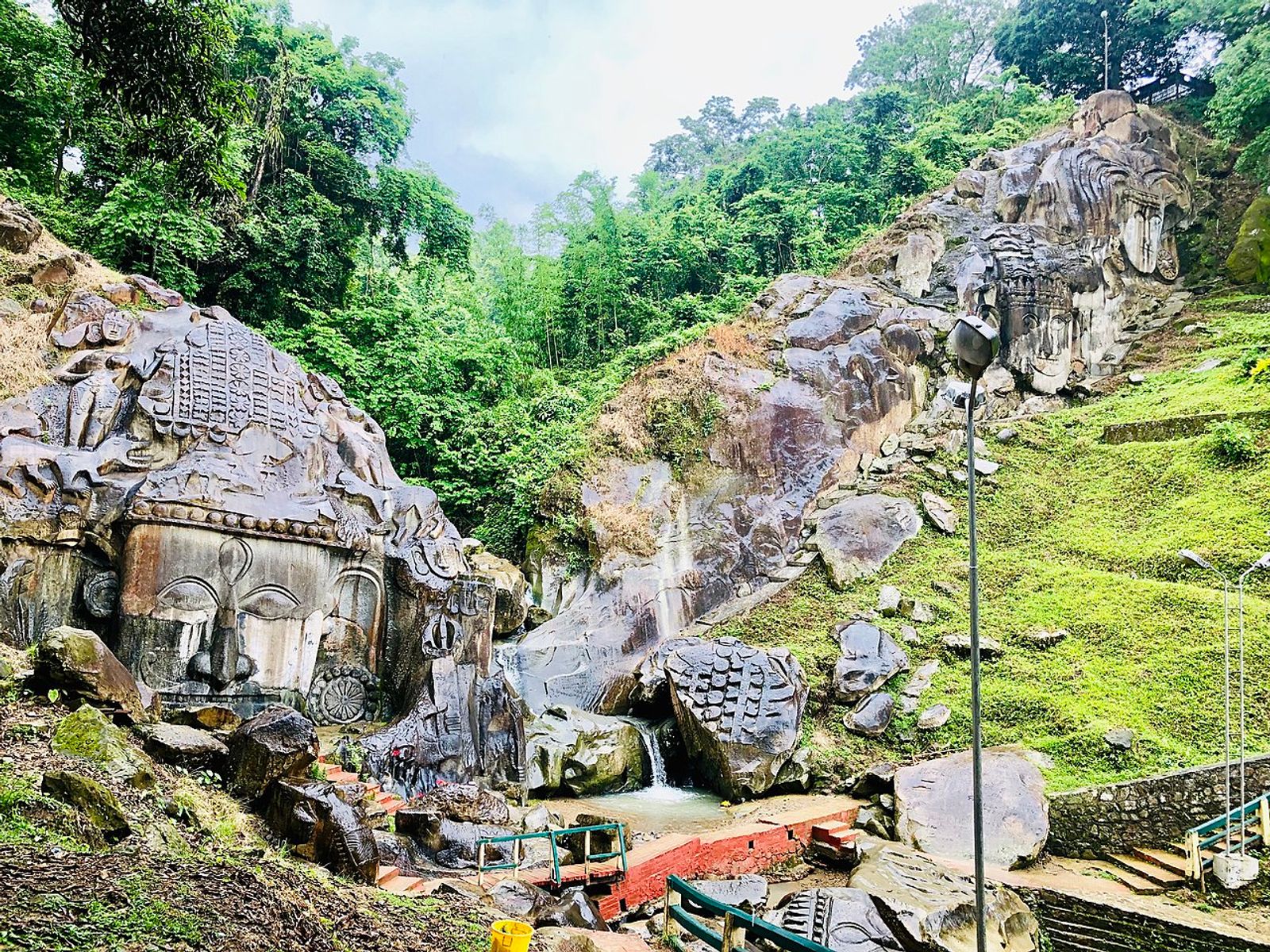
The number is specific and it matters: nine million, nine hundred and ninety-nine thousand, nine hundred and ninety-nine. One less than a crore. Unakoti, in Bengali, means one less than ten million. This is the count, according to the legend, of the stone figures carved into a cliff face in northern Tripura — gods, goddesses, animals, and figures that resist classification — left there by a curse that is now over a thousand years old.
The legend goes like this. Shiva was traveling to Kashi for a great festival and gathered a crore of gods to travel with him. He camped at Unakoti and made a rule: everyone must rise before dawn, or be left behind. In the morning, every god slept through the call. Shiva, furious, cursed them all to remain as stone for eternity and continued to Kashi alone. The figures in the cliff are the ones who could not wake up. They are still there, waiting.
What the Jungle Kept
You do not find Unakoti. Unakoti finds you, in the sense that nothing about the scale of it is legible until you are standing in front of it, and then it is too large to look at all at once. The central figure is a bas-relief of Shiva — Unakotisvara Kal Bhairava, the presiding deity — standing fourteen feet tall in a carved niche. On either side of his head are the carved faces of two goddesses. His hair, fanned out in the Rudra style, fills the rock behind him like a storm arrested mid-motion.
Below him, to the left and right, other figures crowd the cliff face. Some are large enough to require scaffolding to study. Some are small enough to miss if you are not looking at the right angle in the right light. There are figures that archaeologists have categorised and dated to the eighth and ninth centuries CE, and there are others they have not yet reached, hidden under the moss and root growth that centuries of Tripura's humidity has piled over everything stone.
The Archaeological Survey of India has been working at the site since the 1940s. It is still not finished.
The Forgotten Grandeur
Unakoti is not famous the way it should be. The site receives a fraction of the visitors that go to Khajuraho or Hampi or Mahabalipuram — sites of comparable artistic ambition carved in comparable periods by comparable civilisations. The reason is geography. Tripura is landlocked, bordered by Bangladesh on three sides, connected to the rest of India by a narrow corridor. The highway from Agartala to Unakoti takes four hours. There is no airport nearby.
The woman who has come from Agartala has been making this trip every Ashokastami for thirty years. She cannot fully explain why, when asked directly — or rather, the explanation she gives ('because we come, because we have always come') is the whole answer, and she knows it is the whole answer even if it sounds incomplete to someone who has never stood in front of those fourteen feet of stone before dawn.
The visitors who do come tend to be pilgrims, not tourists — people who have traveled specifically to see this, who have known about it for years, who arrive with the particular quiet of people who have been looking forward to something for a long time. During Ashokastami in April, tens of thousands of devotees gather at the pool below the carvings for a ritual bath. The gods in the cliff watch this, as they have watched everything here for a thousand years, without surprise.
The River Beneath
A stream runs through the site, cold and clear even in summer. Its source is the cliff itself — water seeping through the rock, finding paths between the carved figures, emerging at the base of the Shiva relief as if from the god himself. The pilgrims drink from it. The archaeologists have noted that the constant moisture is both what preserved the soft sandstone carvings from wind erosion and what, over the long run, will dissolve them. The stone faces, patient as they are, are slowly returning to the hill.
In the forest around the site, the howling of langurs carries through the trees in the morning. The monkeys have been here as long as the carvings. They watch the visitors with the same expression as the carved figures — a kind of ancient, unremarkable attention. Everything here has been looking at everything else for a very long time.