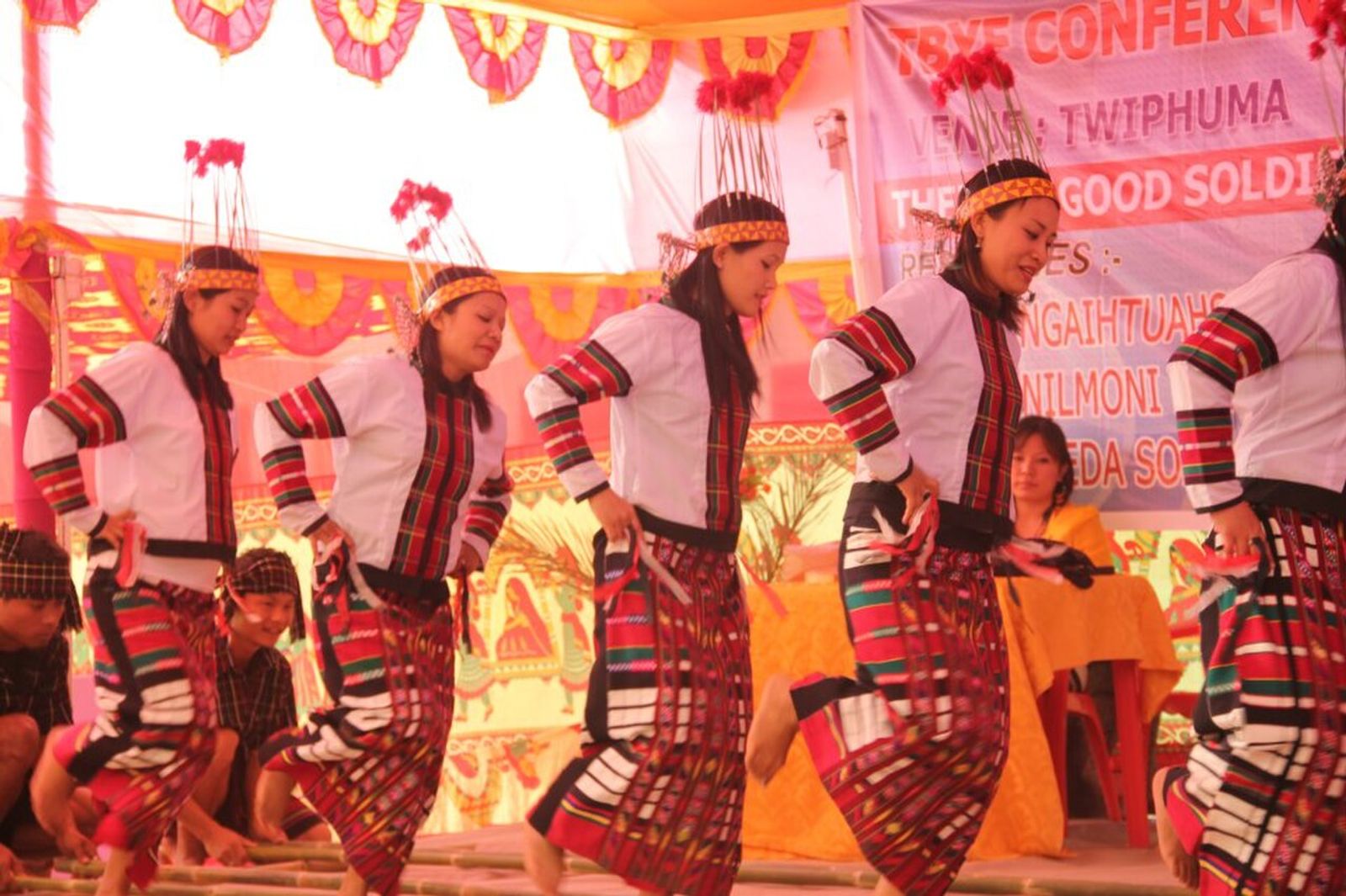
Four people sit on the ground, facing each other in two pairs, each pair holding a long bamboo pole. They begin to clap the poles together in a rhythm — open, closed, open, closed — and into this rhythm, a dancer steps. The bamboo swings toward the dancer's feet, toward her legs, toward the space her body occupies. She does not flinch. She weaves. She has been practicing this since she could walk, and her feet know the intervals between the claps the way the rest of us know the gap between heartbeats: without thinking about it at all.
This is the Cheraw. It is Mizoram's most famous dance, performed at weddings and festivals and state occasions, taught in schools, practiced in villages, referenced by the Mizo people when they want to explain something essential about who they are. Its origin is contested — one version says it was created to pacify the soul of a woman who died in childbirth, as part of a ritual to ease her passage. Another says it was always celebratory, a harvest dance. The two accounts are not necessarily incompatible.
Tlawmngaihna
To understand the Cheraw, you have to understand Tlawmngaihna — the untranslatable Mizo concept that governs social life in the state. It is roughly rendered as selfless service, or the duty to help others without being asked, without expectation of return. But Tlawmngaihna is not altruism in the Western sense, which has an undertone of sacrifice. Tlawmngaihna implies that this is simply what you do. The community exists, you are part of it, and so you act accordingly.
The Cheraw embodies this. The dance requires the people on the ground to be absolutely precise — if they misjudge the rhythm, the dancer's feet pay for it. It requires the dancer to trust completely that the people holding the poles know what they are doing. It requires everyone to subordinate their individual performance to the collective one. The dance succeeds or fails as a whole. There is no version in which the dancer does brilliantly and the others do badly.
The Blue Mountain
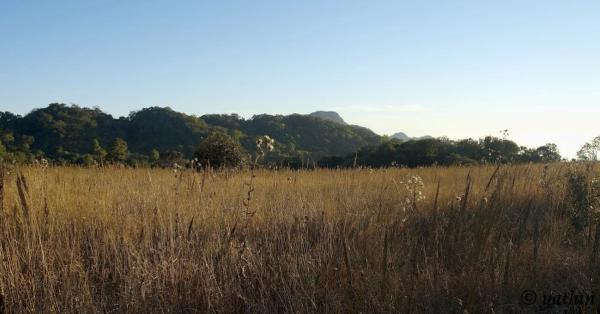
Phawngpui, which means Blue Mountain, is the highest peak in Mizoram at 2,157 metres. On clear mornings, it earns its name: the mist that clings to the ridge gives the mountain a bluish cast against the sunrise, visible from villages an hour's walk away. The mountain is a national park, home to clouded leopards and Blyth's tragopan and orchids that exist nowhere else. The Mizo have considered it sacred for as long as they have lived within sight of it.
There is a story that the mountain is home to a creature — never fully described, never named — that protects the forest. Villagers near the park still report hearing it at night, though they disagree on what it sounds like. The forest department has set up cameras. The cameras have photographed many things. They have not photographed the creature. This, the villagers note, is not particularly surprising.
The Literacy That Arrived Early
In 1894, a Welsh Baptist missionary named William Williams arrived in Mizoram and made a decision that changed everything: he transcribed the Mizo language using the Roman script, giving a written form to something that had only ever been spoken. Within a generation, the Mizo had a literature where there had been none, and they took to it with a speed that surprised everyone, including the missionaries. By the 1930s, Mizoram had a newspaper. By independence, it had a reading population literate in both Mizo and English. The literacy rate today is over 91 percent — one of the highest in India.
To watch the Cheraw is to understand that the bamboo is not an obstacle. The bamboo is the music made physical, and the dancer is the melody passing through it. The poles clap open. The feet find the gap. The rhythm continues. In Mizoram, this is how most things work.