The bridge is alive. This is not a metaphor.
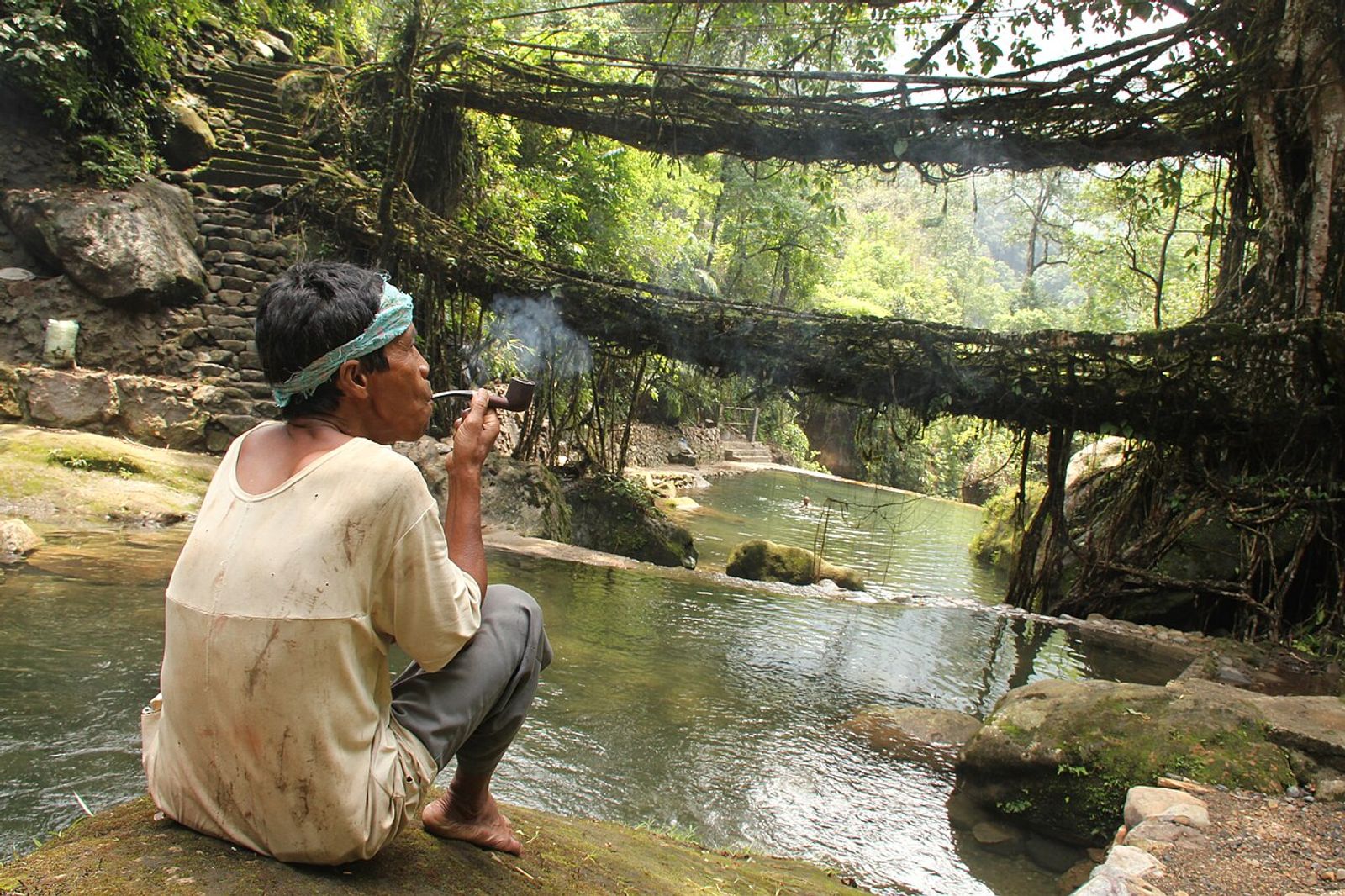
In the village of Nongriat, three hundred stone steps below the road, a bridge crosses a gorge in the hills of Meghalaya. It was not built. It was grown. The roots of a rubber fig tree — Ficus elastica — were guided across the gap over the course of fifteen years, fed through the hollow trunk of a betel nut palm to keep them pointing in the right direction, encouraged to grip the far bank, and left to do the rest. They grew into each other. They fused. They became something that engineers, when they first studied these structures, could not quite classify.
The Khasi people who made it call it jingkieng jri. Living bridge.
The Rain That Builds
Cherrapunji receives more rain than almost anywhere on earth. Between June and September, the sky doesn't break — it simply opens. Rivers appear overnight. Gorges fill. Paths that existed at dawn are gone by afternoon. For centuries, the Khasi and Jaintia peoples of these hills had to cross water that wanted to swallow everything man-made. Wood rots. Stone slides. Rope dissolves in perpetual damp.
So they found something that wouldn't.
A mature Ficus elastica puts out secondary roots from its trunk and branches — aerial roots, thick as rope, that reach toward the ground and anchor the tree against the pull of the hills. The Khasi learned to read these roots differently. Not as anchors. As raw material.
The technique has no recorded origin. It exists in practice, passed from mother to daughter and father to son, not in any text. You take a young rubber fig growing on one bank. You guide its roots toward the other. You build a scaffolding from the hollow trunk of a betel nut palm — a natural tube, which keeps the root growing in a single direction instead of branching and spreading. You wait. Ten years. Fifteen. Sometimes twenty-five. The root reaches the other bank. You encourage it to grip. Over time, additional roots are woven in. The structure knits itself together, root by root, until you have something that bears weight the way bones bear weight: from the inside out, stronger under load than in repose.
The Nongriat double-decker bridge is the most famous: two bridges stacked one above the other, the upper built after the lower proved itself, reaching fifty metres across a gorge that fills with white water every monsoon. It is over five hundred years old. It has never needed repair. It cannot be repaired — it is continuous with the living tree. Every year, it adds a few new roots. Every year, it grows slightly stronger.
A Different Relationship With Time
The man who begins a root bridge does not expect to see it finished. He guides the first roots across the gap, arranges the betel palm scaffolding, encourages the early growth — and then steps back, knowing that the bridge he has started will take fifteen or twenty years to be usable, and that he will likely not be the first person to cross it. He builds it for whoever comes next.
The man who begins a bridge will not cross it. He builds it for his grandchildren, knowing he will not live to see it finished.
This is a kind of patience that requires a different relationship with time than most cultures currently maintain. You have to believe, with certainty, that the future will happen. That there will be grandchildren. That the village will persist. That the rain will keep coming and the river will still need crossing.
In a place that receives eleven metres of rainfall per year, certainty about the rain is perhaps the easiest part.
Seventy-Five Living Bridges
There are estimated to be around seventy-five living root bridges still standing in Meghalaya. Most are in the East Khasi Hills, in villages so remote that reaching them requires two hours of driving, followed by hours of descent on steps carved into hillsides steep enough to make a path impractical. Some bridges are known only to the villages they serve. Researchers mapping them sometimes find themselves the first outsiders to photograph a structure centuries old.
The bridges that tourists visit — Nongriat, Mawlynnong — are famous precisely because they are accessible, which makes them unusual. The typical living root bridge does not perform for anyone. It simply crosses a river, every day, in the rain.
Stronger With Use
In 2019, a team of computational biologists and structural engineers published a study on the Meghalaya root bridges. They were trying to understand the mechanical properties of a structure that was simultaneously a tree, a scaffold, and a bridge. What they found was that the bridges strengthen with use. The roots respond to load the way bone responds to stress — by growing denser where they are needed most. A bridge that carries more weight develops more root mass to carry it. A bridge that is forgotten and stops being crossed, they hypothesised, would eventually revert to being merely a tree.
The bridges need to be used to survive. They are not monuments. They are not heritage. They are partnerships, and like all partnerships, they require continued engagement from both parties.
The Khasi cross them. The tree responds. The crossing continues.
This, the researchers wrote in their conclusion, is perhaps the only form of infrastructure in the world that improves with age.