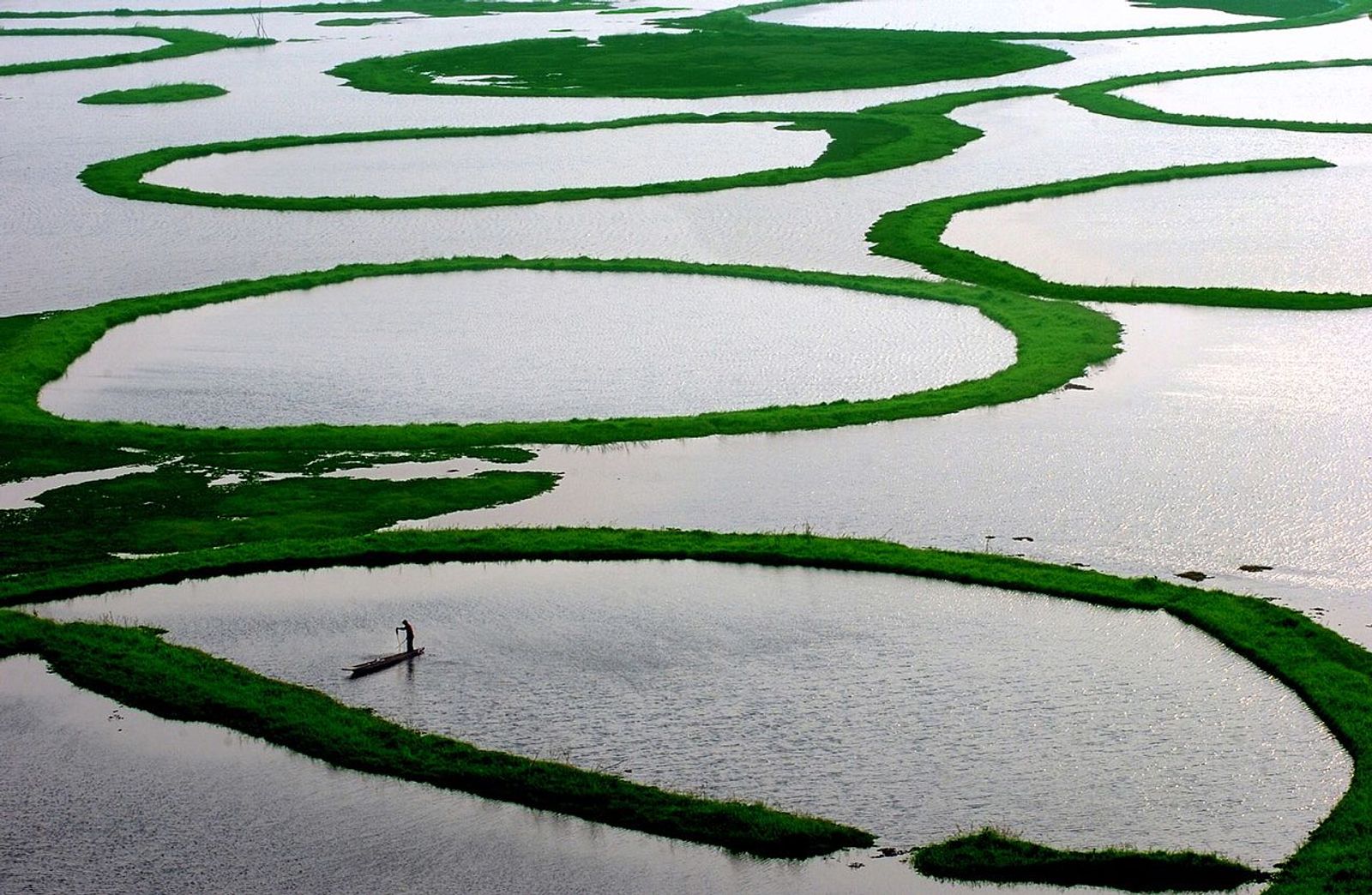
She knows the season is turning by the way the floor gives underfoot. Her house sits on a phumdi — a floating island of compressed vegetation on Loktak Lake — and the phumdi tells her things the calendar cannot. A certain softness underfoot means the monsoon is building. A certain firmness means the dry season has arrived and the mat has settled. She has lived on this lake her entire life. The lake has been telling her things the entire time.
Loktak is the largest freshwater lake in Northeast India, stretching across 280 square kilometres of the Manipur valley, ringed by hills and fed by rivers that bring sediment from across the state. The phumdis are its most extraordinary feature — floating mats of aquatic vegetation so dense that they support not only their own weight but the weight of houses, boats, nets, and the daily lives of the communities that have inhabited them for generations.
The Houses That Float
A fisherman's hut on a phumdi is built on bamboo supports driven into the floating mat below. The mat flexes under weight but does not break. In the dry months, when the water level drops, the phumdi drops with it, and the house descends. In the monsoon, when the lake rises, everything rises with it. The house does not flood. The island absorbs the change. This adaptability is not accidental — it is the entire point.
The families who live on the phumdis have done so for generations, in a relationship with the lake so old it has become invisible, the way long relationships become invisible. They fish the lake. They grow vegetables on the mat. They travel by small wooden boat between the floating islands and the shore markets, selling catch, buying rice, returning by evening. The lake is not their backdrop. It is their floor.
The Last Dancing Deer
The Keibul Lamjao National Park occupies the southern end of Loktak Lake, covering roughly forty square kilometres of phumdi. It is the only floating national park in the world. And within it lives the Sangai — the brow-antlered deer, called the dancing deer in Manipuri, for the way its legs move through the dense vegetation of the mat: high-stepping, deliberate, the gait of a creature that has been walking on uncertain ground for so long that uncertainty is simply the ground.
The Sangai is found nowhere else on earth. At its lowest, in the 1970s, the total population was estimated at fourteen individuals. Conservation efforts, park protection, and a genuine effort by Manipur's communities — for whom the Sangai is a state symbol and something approaching a sacred animal — brought the population back. The last census counted over 260. This is still very few. But it is not fourteen.
The Barrage and the Threat
In 1983, the Ithai barrage was constructed downstream on the Manipur River to support a hydroelectric project. The barrage raised the lake's water level by an average of one metre. One metre does not sound like much. On a flat, shallow lake like Loktak, one metre changes everything. The phumdis, accustomed to a natural cycle of rise and fall that allowed them to regenerate in the dry months by resting on the lakebed, were now permanently submerged. They began to thin. Their density decreased. Some disappeared.
The communities on the lake began to notice the change in ways that studies and government reports eventually confirmed: fewer fish, smaller phumdis, more instability in the mats that remained. The debate over what to do about the barrage has been running for forty years. It involves the electricity needs of Manipur, the ecological requirements of a UNESCO-designated Ramsar wetsite, and the livelihoods of roughly 100,000 people whose lives are organised around the lake.
To live on a phumdi is to have made a particular kind of peace with impermanence — to accept that the ground beneath you is alive, that it breathes with the lake, that permanence was never the arrangement. The lake families understand this. What they are less at peace with is a permanence imposed from outside: a fixed water level that does not breathe, a barrage that does not negotiate. The lake can handle its own impermanence. It is the rigid certainty of concrete that is harder to absorb.